
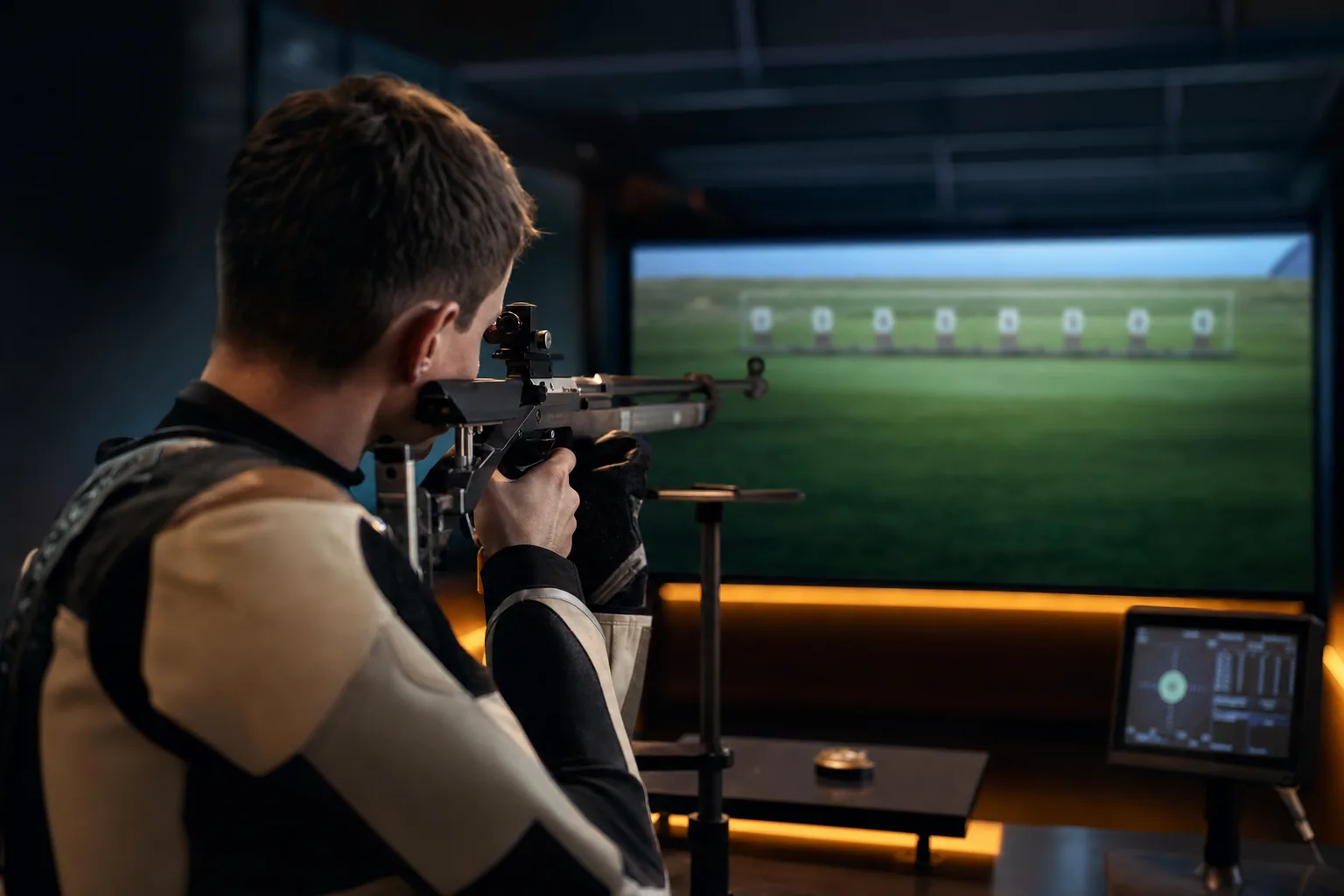
Sport shooting
Sport shooting simulator
Marksman ST3 trains skeet, trap, sporting and biathlon with your own shotgun or rifle. Targets launch on your voice call, and each shot replays with gun path, lead and swing speed. 0.18 MOA optical tracking, 1 ms shot-to-screen.
Skeet, trap, sporting
Plus biathlon
Voice call
Targets launch on your call
0.18 MOA
1 ms shot-to-screen
Why train off the range
The record, not the feeling
Every shot is stored. You do not leave with a sense that it went well.
The same target, again
A problem target comes back as many times as you ask. On the range you get it once in the round.
Year-round, without shells
No weather, no waiting for a free stand, no ammunition.
Where the gun actually was
Swing speed, lead, and the moment the shot broke. A coach behind you cannot see all three.
What the range does not show
The tracker measures the barrel more finely than the error you are looking for. You see where you pointed, and how fast the gun got there.
Mount and gun path
From the gun coming to the shoulder through the shot. Straight to the target, or under it and back.
Swing and lead
Angular speed at the shot, and whether you were ahead, behind, or on it.
A stopped gun
A stopped swing changes the lead and the target flies on. On the range you cannot see it. Here it is on the curve.
Lead on a moving target
Lead is target speed times time of flight. Speed is a preset in km/h so the chart does not claim an animal’s pace. The silhouette is a running-boar outline.
Target speed
Impact
Aim here
101 cm ahead
.308 Win. · Norma Ecostrike 150 gr: 101 cm ahead at 100 m, 30 km/h.
At 100 m and 30 km/h, .308 Win. · Norma Ecostrike 150 gr needs 101 cm of lead.
What you can shoot
ISSF clay disciplines, sporting, and the shooting part of biathlon. Speed, direction and angle can change, and you can save the setting.
Skeet
High house and low house, fixed trajectories, singles and doubles.
- Skeet
Trap
The target leaves the trench ahead of you. Direction and angle are not known in advance.
- Trap
Sporting
Incoming, outgoing, crossing and quartering targets, including the clay-shooting layouts clubs actually shoot.
- Sporting
- Clay shooting
Biathlon
Five targets, prone and standing, with the ballistic profile of your cartridge.
- Biathlon
You miss on station 6. The question is why.
Two different errors look the same on the range: the target keeps flying. Either you were late onto it and chased, which is mount and stance. Or you were there in time and stopped the gun as you fired, which is trigger and follow-through.
Late onto the target
The fix is the mount and the stance.
Stopped gun
The fix is the trigger and the follow-through.
Replay the shot slowly
What took a few tenths of a second, you walk back through for as long as you need.
- The path of the gun, from the mount through the shot and past it.
- The path of the target, and the point where the shot broke.
- Lead and swing speed, including a gun that stopped.
- The pattern, for the cartridge and the choke.
Who comes here
Competition shooters
Keep the timing between events, and through the winter, with a record of every shot.
Coaches and juniors
Show the student that the gun stopped, instead of explaining it over a missed target.
Sporting and hunting-layout shooters
Prepare the season without the cost of targets and without waiting for a free stand.
Simulator or the range
Better on the simulator
- Repetitions in one visit, without the cost of shells.
- Gun path, lead, and the moment of the shot.
- A slow replay the range does not have.
- The same target presentation, as many times as you need.
- No dependence on weather or a free stand.
Go to the range for this
- Recoil. There is no ammunition, so the shoulder does not take the shot.
- Noise, smoke, and the rest of a live shot.
- Fatigue across a full competition round.
- Wind, sun, and the background of that ground.
- Handling ammunition and loading.
It is a complement to live fire, not a replacement. It saves ammunition and time, and it gives you a record the range does not.
How a session runs
- 01
You arrive with your firearm
Unloaded, in a case. Ammunition stays out of the room.
- 02
Tracker and calibration
The tracker mounts on the barrel. The firearm is not modified.
- 03
You choose the discipline
With the instructor, for the target you want to work on.
- 04
You shoot on your own call
Then you read gun path and lead before you leave.