
Law enforcement
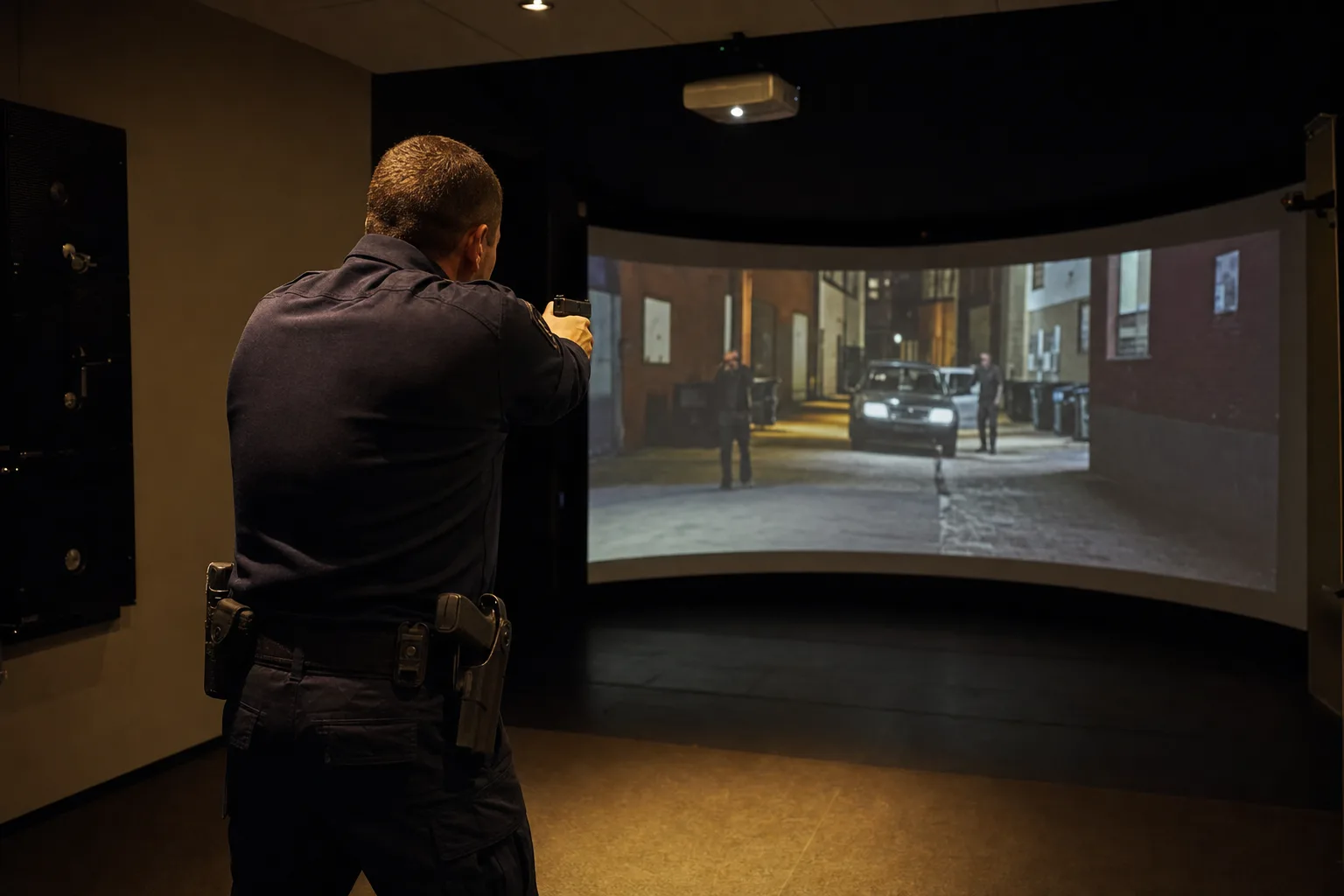
Law enforcement training simulator
Marksman ST3 trains law enforcement firearms skills with a real handgun or rifle: trigger control, shoot / don't shoot decisions, multiple targets and reaction time, with every shot recorded at 0.18 MOA and 1 ms shot-to-screen.
0.18 MOA
About 5 mm at 100 m
1 ms
Shot-to-screen
Shoot / don't shoot
Decision, not only the hit
Why the record matters
Your own sidearm or rifle
The tracker mounts on the firearm. No laser insert.
The cause, not only the hole
A hit low and left can be a flinch or a bad hold. The record separates them.
Decisions
Shoot / don't shoot, more than one target, and the time from the cue to the shot.
Repetition without ammunition
The round count of a session does not depend on the ammunition budget.
Marksmanship under stress
Shoot / don't shoot and multiple targets, with the clock on the record.
Every session is documented
Hits, time, and the decision stay on the record for the instructor.
What you can train
On a paper target you see a hole. Here you see why it is there.
The hit
Trigger press, the path of the barrel before the shot, and whether the sights stayed after it.
The decision
Shoot / don't shoot, a threat among people who are not a threat, and a target that is partly hidden.
Time
Reaction time from the cue to the shot, and the time between shots.
Rifle drop
Point-mass G1 from the ST3 ballistic engine. Sight 5 cm above the bore, no wind. Swap the loads or the zero; the curves recompute.
- 5.56 NATO · Hornady FMJ 55 gr
- .308 Win. · Norma Ecostrike 150 gr
| Distance (m) | 5.56 NATO · Hornady FMJ 55 gr | .308 Win. · Norma Ecostrike 150 gr |
|---|---|---|
| 100 m | -0.0 cm | 0.0 cm |
| 200 m | -8.6 cm | -10.8 cm |
| 300 m | -35.6 cm | -40.7 cm |
G1 drag, 9.81 m/s², 5 cm sight height, factory muzzle velocity and ballistic coefficient from the ST3 ammo database.
At 200 m, .308 Win. · Norma Ecostrike 150 gr drops 2.3 cm more than 5.56 NATO · Hornady FMJ 55 gr.
The drills
Static work, then decisions, on the firearm the officer carries.
Static
A fixed target and the fundamentals of the hit.
- Trigger
- Hold
Shoot / don't shoot
Who, and when. Not only whether the shot lands.
- Decision
More than one target
Transitions, a partial target, and people who are not the target.
- Transitions
A hole low and left is not a diagnosis
On the range you see the hole. Here you see the cause. Either the aim was steady and the last moment yanked the shot, which is the trigger. Or the aim was never steady, which is stance and grip. On paper they look the same.
A yank at the shot
The fix is the trigger.
An unsteady hold
The fix is stance and grip.
Replay the run
Every shot stays on the record, including the movement of the firearm.
- The path of the barrel before the shot.
- Movement in the last moment before the shot.
- Where the hit sits against the point of aim.
- Time from the cue, and time between shots.
Who trains here
Agencies
Keep the skill between live-fire cycles, with a record of every shot.
Instructors
Show the student the record instead of describing a hole in the target.
Licence holders
Decision drills on their own firearm, without the cost of ammunition.
Simulator or the range
Better on the simulator
- A record of every shot, including how the firearm moved.
- No ammunition.
- The same decision drill, repeated.
- No dependence on a free range slot.
Go to the range for this
- Recoil, and managing it.
- Noise, and the rest of a live shot.
- Loading, stoppages, and handling ammunition.
- The weight of a loaded firearm.
It is a complement to live fire, not a replacement. It saves ammunition and time, and it gives you a record the range does not.
How a session runs
- 01
The firearm arrives unloaded
In a case. Ammunition stays out of the room.
- 02
The tracker goes on
No modification to the firearm. A handgun needs a rail for the mount.
- 03
You choose the drill
With the instructor.
- 04
You shoot, then read the record
You leave with the result, not with an impression.