
31 July 2023
Shotgun cartridge for beginners
Shotgun cartridge & shotshell ballistics — expert guide
This guide explains how shotgun cartridges (called shotshells in the US) affect your hit: pellet size, charge weight, material choice, and distance. Use the ballistics charts below with data from Marksman ST3 simulators.
Will my cartridge choice influence my hit?
Yes. Your hit is a direct consequence of your cartridge choice. Choose your cartridge with full knowledge of the facts — for the game you hunt, the distances you shoot, and your shotgun's gauge. In partnership with ballistics experts from BASC (British Association for Shooting & Conservation), the Marksman ST3 shooting simulator helps you test cartridge choices before you go afield.
Efficiency
3–5 pellets Energy Penetration
The effectiveness of a shotgun shot intended to kill game cleanly depends on two factors:
- Number of pellets striking the bird: a minimum of 3 to 5 pellets is required for reliable lethality;
- Pellet velocity on impact: a partridge is more fragile than a duck, so the velocity needed to penetrate (through skin and flesh, and to break bone) and to deliver a killing shock to the nervous system is lower for partridge than for duck.
Cartridge specifications
Pellet type Pellet size Pellet charge Gauge
The diagram below shows the anatomy of a shotgun cartridge. The firing pin strikes the primer, igniting the powder and propelling the pellets at more than 400 m/s as they leave the muzzle.
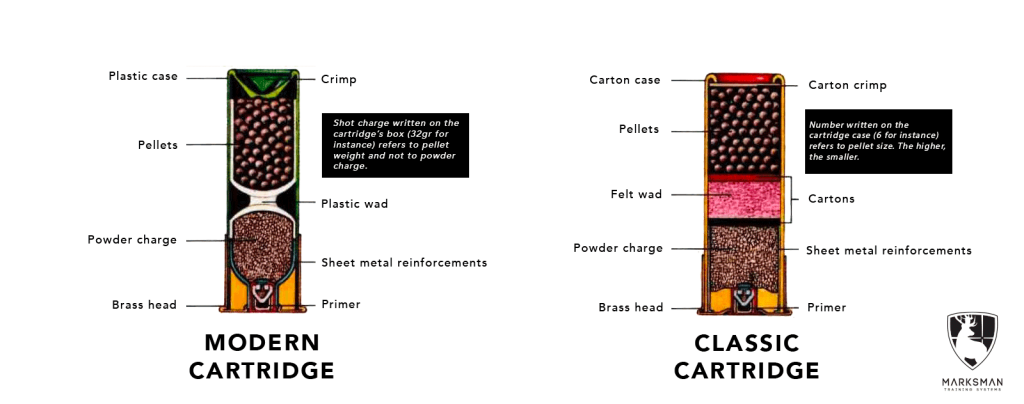
Cartridge choice has a real influence on your shot. The main criteria are:
- Pellet type: lead, bismuth, steel, zinc, copper, tungsten, and tungsten (TSS);
- Pellet size: from 1 (4 mm) to 9 (2 mm) in the EU numbering system;
- Pellet charge: typically 24 g to 36 g.
Pellet type
Lead is the most widely used pellet material for all types of game. The exception is where regulation forbids it. In many countries, lead is banned in wet zones (within 30 m of open water) and when shooting toward water. In those cases, choose steel or bismuth.
No lead within 30 m of water, and no lead shot toward the water from any distance. Steel or bismuth when ducks are over the wet zone.
Pellet size
Pellet number reflects pellet diameter: the smaller the number, the larger the pellet. A #6 cartridge therefore has larger pellets than a #9 cartridge. A larger number also means more pellets in the same charge weight. Here is the relationship between diameter and pellet count for a 32 g load:
Diameter in millimetres. Smaller EU number = larger pellet. Data from ST-Classic ballistic tables.
Pellet charge and gauge
Shot charge is often matched to shotgun gauge: 32 or 36 g in 12 gauge; about 30 g in 16 gauge; 28 g in 20 gauge; and 24 g in 28 gauge. Pellet charge does not change individual pellet speed for a given load design — it changes how many pellets are in the pattern. Example for a #6 cartridge:
Comparing the two charts above, pellet size has more influence on pellet count than charge weight. Choosing the right pellet number matters more than adding a few grams of shot.
Which material retains velocity best?
Heavier = retains speed longer Different pellet charge = same initial speed
Lead is denser than steel, so it loses velocity more slowly in flight — extending effective killing range. Bismuth sits between lead and steel in density; it slows less quickly than steel but costs more.
Minimum pellet speed by game type
Pellet speed at the muzzle depends on pellet size for a given material and barrel length — not on charge weight. To pick the right pellet size, you need the minimum impact velocity to kill each species. More fragile animals require lower impact energy.
| Species | Speed | Species | Speed |
|---|---|---|---|
| Goose | 220 m/s | Fox | 210 m/s |
| Hare | 205 m/s | Duck (mallard) | 195 m/s |
| Pheasant | 185 m/s | Rabbit | 180 m/s |
| Pigeon | 180 m/s | Partridge | 175 m/s |
| Woodcock | 165 m/s | Snipe | 155 m/s |
Reference speeds (m/s) for common quarry. Use with your distance tables when choosing pellet energy at range.
Which pellet size for which game?
The six most versatile Favour one pellet size in the field
Which pellet size gives a killing shot between 35 and 40 m? Lead #6 is the most versatile — suitable for duck, pheasant, rabbit, and pigeon. It can work for hare and partridge, though dedicated sizes exist for those birds.
| Game | Pellet size | ||||||||
|---|---|---|---|---|---|---|---|---|---|
| 1 | 2 | 3 | 4 | 5 | 6 | 7 | 8 | 9 | |
| Goose | |||||||||
| Fox | |||||||||
| Hare | |||||||||
| Duck (mallard) | |||||||||
| Pheasant | |||||||||
| Rabbit | |||||||||
| Pigeon | |||||||||
| Partridge | |||||||||
| Woodcock | |||||||||
| Snipe | |||||||||
EU pellet numbers 1 (largest) through 9 (smallest). Duck over water: steel or bismuth, not lead.
Conclusion
This guide gives you a starting point for cartridge choice by game. Other factors matter too: barrel length (longer barrels can push effective range), choke constriction (tighter chokes concentrate energy downrange), and lead on moving targets. For driven shooting, keep the same pellet number and cartridge type so your lead stays consistent. Start the mount behind the bird, swing through, pull, and follow through.
Try our hunting simulator to see how cartridge choice changes your pattern and impact — and to correct swing and timing before the season opens.
Frequently asked questions
Does shotgun cartridge choice affect my hit?
Yes. Pellet size, charge weight, and material (lead, steel, bismuth, or alternatives) change pellet count, energy, and pattern density. Matching the cartridge to your game and distance is essential for clean, ethical shots.
What is the difference between a shotgun cartridge and a shotshell?
They are the same thing. Shotgun cartridge is standard in the UK and Europe. Shotshell or shotgun shell is more common in American English. Both mean the complete round: hull, primer, powder, wad, and shot.
What does the number on a shotgun cartridge mean?
The number on the case (for example EU #6) refers to pellet size — higher numbers mean smaller pellets. The weight on the box (for example 32 g) is the shot charge, not the powder load.
When must I use steel or bismuth instead of lead?
Near open water, many rules require non-toxic shot within 30 m of the water, and lead is not allowed when shooting toward the water from any distance. Steel or bismuth is required in those situations.